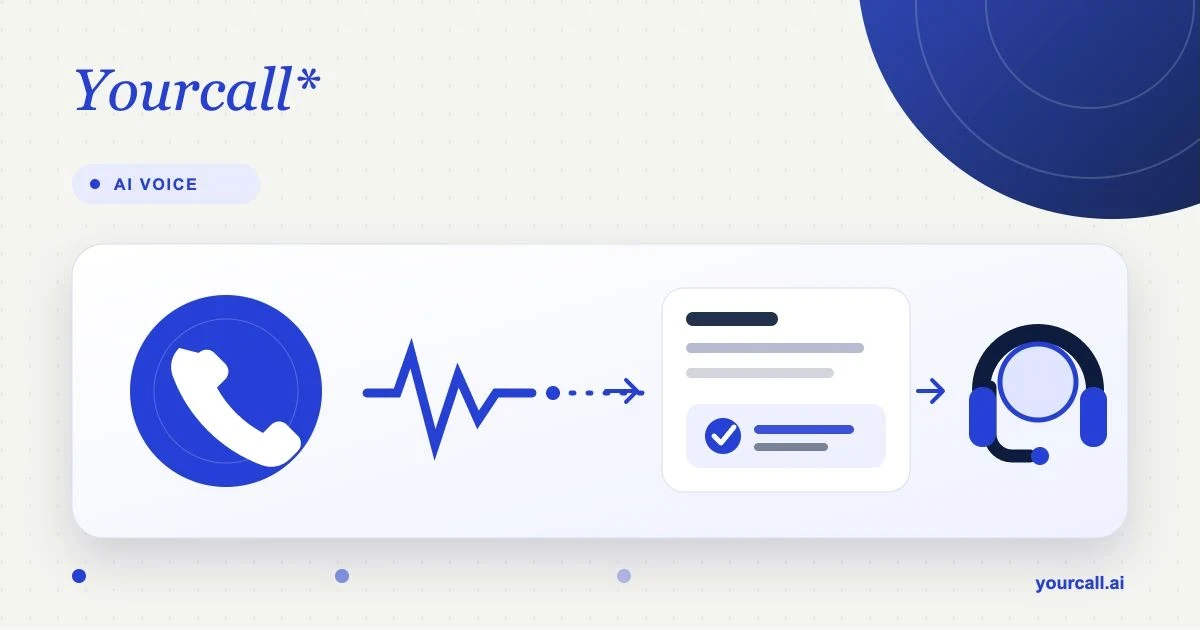
For most businesses, the phone is still where the highest-intent conversations happen. A prospect calls to ask if you can solve their problem. A customer calls because something went wrong. A guest calls to book, change, or confirm. Yet these calls keep arriving at the worst moments: during a rush, after hours, or when every line is already busy. An AI phone system is built for exactly this gap.
An AI phone system answers inbound calls with a natural-language voice agent that understands what the caller wants, holds a conversation, can complete approved routine tasks when connected to the relevant systems, and hands off to a person when the situation calls for it. It is not a recorded menu and not a chatbot bolted onto a phone line. It is a reception layer that listens, reasons, and acts within a defined scope.
This guide explains what an AI phone system is, how it works under the hood, the seven capabilities that separate a useful system from a gimmick, how it compares to IVR and call centers, where it delivers value across industries, and how to evaluate one for your business.
The timing is not incidental. Customer expectations have moved faster than many reception setups: people value prompt answers, clear understanding, and requests that can be handled during the conversation. At the same time, staffing every peak and every after-hours window is difficult. An AI phone system can extend coverage on selected call types without staffing each additional interval, provided its scope, integrations, and human handoffs are designed and tested.
What is an AI phone system?
The distinction that matters most is between routing and resolution. A traditional auto-attendant routes: it asks you to "press 1 for sales, press 2 for support," then sends you somewhere. An AI phone system resolves: it asks what you need, understands the answer in plain language, and either completes the task or routes you to the right person with context already gathered.
It also differs from a generic chatbot. A chatbot platform handles text on a website; an AI phone system handles live voice over the telephone network, with the added demands of real-time speech, interruptions, accents, and background noise. The two can share knowledge and integrations, but the voice channel is its own discipline.
It is also worth separating the AI phone system from the underlying telephony. The phone numbers, lines, and carrier connections are infrastructure that most businesses already have. The AI phone system is the intelligence layer that sits on top of that infrastructure: it answers the calls those numbers receive and decides what happens next. That means adopting one rarely requires ripping out an existing setup; it more often means pointing inbound calls at a new, smarter front door.
For a business, the practical definition is simpler still: it is a way to reduce unanswered calls and waiting time on selected routine requests, while creating an agreed record of the conversations the agent handles.
How does an AI phone system work?
Behind a single phone call, an AI phone system runs a short pipeline that repeats on every turn of the conversation. Understanding these layers helps you evaluate vendors, because weakness in any one of them shows up as a frustrating call.
Speech recognition
When the caller speaks, automatic speech recognition (ASR) converts audio into text in real time. Good ASR handles accents, hesitations, names, and noisy phone lines. It also detects when the caller has finished a thought, so the system can respond without awkward delays or talking over the caller.
Natural-language understanding
The transcribed text is interpreted to extract intent and key details: the caller wants to change a reservation, the date is Friday, the name is on file. This is where a modern language model outperforms older keyword matching, because callers rarely phrase requests the way a script expects.
The integration layer
This is the difference between a system that talks and one that acts. Connected to a PMS, CRM, booking engine, or ticketing tool, the AI can look up a reservation, check availability, write an update, and log the outcome. Without integrations, an AI phone system is just a smarter answering machine.
Handoff and escalation
When a request exceeds the AI's scope, when sentiment turns negative, or when the caller simply asks for a person, the system escalates. A clean handoff includes a spoken or written summary so the human picks up mid-context rather than starting over. The transcript and outcome are then logged for reporting and quality review.
Text-to-speech and the response loop
Once the system decides what to say, text-to-speech turns the response back into natural audio, and the whole loop repeats on the next turn. The quality bar here is latency: a noticeable delay between the caller finishing and the agent responding breaks the feeling of a real conversation. The best systems keep that round trip fast enough that the exchange feels like a phone call, not a transaction with a machine, while still managing interruptions gracefully when a caller talks over the agent.
How to evaluate AI that answers business calls
An AI phone agent or AI phone assistant is the conversational component of an AI phone system. It turns speech into text, interprets the request, consults permitted data, produces a response, and can take an approved action when the workflow allows it. The wider phone system also includes telephony, business rules, integrations, and human handoff paths.
- How it works. Verify which sources ground its answers and which actions the agent can actually complete in each connected system.
- Limits. Define excluded topics, data the agent must not disclose, and what happens when information is missing or ambiguous.
- Human handoff. Test explicit requests for a person, sensitive cases, and team unavailability. The handoff should pass a useful summary or offer an appropriate callback path.
- Pre-launch testing. Use representative calls with accents, background noise, interruptions, and unexpected wording. Measure understanding, action accuracy, and transfer quality.
A pilot on one clearly defined call type lets you compare these outcomes with your starting point. It also shows which rules and integrations need adjustment before you broaden the scope.
7 core capabilities
Not every system marketed as "AI" does all of these well. Many can answer and chat convincingly but stop short of doing anything, leaving the actual work for a human to redo later. The seven capabilities below are a practical checklist for what a business-grade AI phone system should handle end-to-end, from the moment the line connects to the record written after the caller hangs up. Read them less as a feature wishlist and more as the difference between a system that deflects work and one that completes it.
01 Answer promptly
The first job is to answer routine calls consistently and keep waiting time short. Response time is a baseline metric: a prompt answer sets the tone for the interaction and reduces the abandonment that can drive callers to a competitor. The target should be defined and verified in the actual telephony setup.
02 Qualify the request
Before routing or acting, the system identifies why the caller is calling: sales, support, billing, an appointment, an emergency. Accurate qualification means fewer misdirected transfers and a caller who reaches resolution faster, whether that resolution is the AI itself or the right human.
03 Book appointments and reservations
Connected to a calendar or booking engine, the AI can check permitted availability and confirm a slot within the rules you define. This can reduce voicemail back-and-forth and recover some bookings that arrive after hours or while staffed lines are busy.
04 Modify and cancel
Changes are as common as new bookings. A capable system can move a reservation, update a detail, or process a cancellation against the system of record. It should apply configured rules on deadlines and fees, and route exceptions for human review.
05 Upsell and inform
On the right calls, the AI can surface a relevant option: an upgrade, an add-on, a seasonal offer, or simply accurate information that helps the caller decide. Done in the brand's voice and without pressure, this turns a service call into a revenue moment.
06 Escalate cleanly
The mark of a mature system is knowing its limits. When a case is complex, sensitive, or explicitly human-requested, it transfers to the right team with a summary attached. Escalation is a feature to design well, not a failure to hide.
07 Log handled interactions
Calls handled by the configured flow can produce a structured record: intent, outcome, transcript or summary, and any action taken. Subject to consent, retention, and access rules, these records can support reporting, quality review, and CRM history.
AI phone system vs traditional options
To see where an AI phone system fits, it helps to compare it against the three things businesses commonly rely on today: a rule-based IVR or auto-attendant, an offshore call center, and plain voicemail. The table below compares them on the dimensions that actually affect customer experience and cost.
| Dimension | AI phone system | Rule-based IVR | Offshore call center | Voicemail |
|---|---|---|---|---|
| Pickup time | Configured response target, verified in pilot | Instant menu, but no resolution | Varies with queue and staffing | Instant, but no live answer |
| Languages | Multiple, detected per call | Fixed per menu branch | Depends on agent skills | Single recorded greeting |
| After-hours | Configured coverage for approved use cases | Menu only, limited actions | Extra cost for night shifts | Captures message only |
| Cost model | Often usage-based; verify full implementation cost | Low, but caps at routing | Per agent, per hour | Low, but loses revenue |
| Brand voice | Consistent, configurable | Rigid, robotic prompts | Varies by agent and day | Static greeting only |
The point is not that one option is universally best. A simple IVR is fine for a business that only needs routing, and a human call center remains the right answer for complex, relationship-heavy conversations. The advantage of an AI phone system appears when callers expect resolution, when volume is uneven, when service spans languages and time zones, and when brand consistency matters. In practice, many businesses use a blend: the AI handles selected high-volume, repetitive requests within configured coverage, and humans take calls where judgment, empathy, or authority is what the situation requires. The right mix should be set by call type and validated in a pilot.
For a deeper decision matrix covering fit, operating constraints, and hybrid setups, read our comparison of IVR, call centres, and AI agents.
Industry use cases
The value of an AI phone system shows up differently by sector, because the calls themselves differ: travel is about volume and timing, luxury retail is about tone and discretion, insurance is about accuracy and compliance. The examples below show how the configured scope, controls, and pilot measures should change by industry.
Hospitality and travel
In travel, call volume is spiky and seasonal: a weather disruption or a sale can flood the lines in minutes. An AI phone system can add concurrent capacity for selected reservations, changes, schedules, and routine questions. With Corsica Ferries, an inbound and outbound deployment was associated with a meaningful reduction in support load and measurable outbound conversion. For hotels, ferries, and airlines, the pilot should verify handled-call rate, task completion, booking conversion, and quality during real peaks and after-hours windows.
Retail and luxury
Retail and luxury maisons face a different challenge: each handled call is a brand touchpoint. Within a carefully approved catalogue and policy set, an AI phone system can answer availability questions, collect appointment requests for in-store visits, and present relevant options without pressure. Voice, wording, escalation, and recommendation quality should be reviewed by the brand before launch and monitored during the pilot; sensitive or high-value conversations should move to a qualified advisor.
Insurance
Insurance calls are high-stakes and process-heavy: first notice of loss, claim status, policy changes, renewals. An AI phone system can be configured to collect defined fields, read back permitted information from connected systems, and route sensitive or complex cases to an appropriately qualified person with context attached. Any efficiency benefit depends on accuracy, completion, and escalation results measured in the approved workflow. The compliance and accuracy bar is high, which is why integration, audit, and escalation design matter most in this sector.
How to choose: what to evaluate
Most AI phone system demos sound impressive in a controlled setting. The questions below separate systems that perform on day 30 from those that only shine in the sales call. Use this as an evaluation checklist.
- Speech quality under real conditions. Test with accents, background noise, and interruptions, not just a quiet scripted demo.
- Depth of integrations. Can it read and write to your PMS, CRM, or booking engine, or does it only talk? This is the single biggest predictor of value.
- Escalation design. How does it decide to hand off, and does the human receive a usable summary?
- Language coverage. Does it detect and switch languages per call, and is the voice quality consistent across them?
- Brand voice control. Can you shape tone, phrasing, and persona to match how your brand should sound?
- Reporting and transcripts. Are calls handled by the agent logged with intent, outcome, and an appropriate transcript or summary?
- Security and compliance. How is call data stored, and does it meet the requirements of your sector?
- Time to value. How quickly can a focused use case go live, and what does it take to expand from there?
A short, honest pilot on one high-volume call type tells you more than any feature list. Pick the calls that hurt most today, measure before and after, and expand from proof. Resist the temptation to automate everything at once; the fastest path to a stalled project is a sprawling scope that tries to handle every edge case before proving the common one. Start where the pain and the volume overlap, get it working well, and let each win fund the next.
A simple ROI framework
The return on an AI phone system comes from three places: calls recovered that were previously missed, time freed from repetitive handling, and bookings or upsells captured outside staffed hours. A simple way to estimate it:
Recovered value = missed calls per month × answer rate gain × value per answered call
Illustrative example: suppose a business receives several thousand inbound calls a month and currently misses around 20% of them at peak and after hours. If an AI phone system handles a measured share of those calls and a fraction convert to a booking or qualified lead, the recovered revenue can be estimated against the business's own average call value. Compare that range with implementation, telephony, usage, and quality-assurance costs rather than assuming a positive return. Run the calculation with your real call volume and conversion rate to size a testable opportunity.
On the cost side, many AI phone systems scale partly with usage rather than seats, but the model should also include telephony, implementation, integrations, and quality review. Add the time your team gets back from routine questions actually completed by the agent, then compare the measured benefit with the full cost over the pilot period.
To account for the main billing models, cost drivers, and less visible budget items, use our eight-factor AI phone system cost guide.
One caution on the math: cost per answered call can mislead in isolation. The useful comparison includes the value of recoverable high-intent calls, the share the agent handles successfully, downstream conversion, and the operating cost of the deployed workflow. Frame the ROI around measured recovered opportunity first and verified efficiency second.
Frequently asked questions
What is an AI phone system?
An AI phone system is software that answers inbound calls with a natural-language voice agent. It understands what the caller wants, holds a conversation, can complete approved tasks such as booking or modifying an appointment when connected to the relevant system, and hands off to a human when needed. Unlike a rule-based IVR, it does not require the caller to navigate a menu of pressed digits.
How is an AI phone system different from an IVR?
A traditional IVR routes calls through a fixed decision tree of menu options. An AI phone system understands free-form speech, so callers can state their request in their own words without pressing through layers. Within a configured scope, it can also look up information in connected systems, take approved actions, and escalate cleanly rather than only routing.
Can an AI phone system handle multiple languages?
Yes, depending on the solution and its configuration. A multilingual AI phone system can detect the caller's language and respond in it within the languages enabled for that deployment. Businesses should test recognition, voice quality, business rules, and handoffs in every language they plan to offer.
Will callers know they are talking to an AI?
A well-configured AI phone system is transparent about being an assistant and speaks in the brand's tone. The goal is not to imitate a person but to resolve the request quickly and hand off to a human when the situation calls for it. Clear, fast, accurate handling matters more to callers than disguising the technology.
What happens when the AI cannot handle a call?
When a request falls outside its scope or a caller asks for a person, the AI phone system escalates. It can warm-transfer to the right team with a spoken summary of the conversation, capture a callback request with full context, or route based on urgency. Escalation is a designed feature, not a failure mode.
How long does it take to deploy an AI phone system?
Timelines depend on scope and integrations. A focused deployment handling FAQs, qualification, and booking can go live in a few weeks, while flows that connect to a PMS, CRM, or booking engine and serve multiple languages take longer. Most of the effort goes into mapping call intents and connecting systems, not the voice layer itself.
How should a business test AI that answers phone calls before deployment?
Prepare a representative sample of calls with unexpected wording, accents, background noise, and out-of-scope requests. Verify understanding, the accuracy of approved actions, safe behavior when the system is uncertain, and transfer to a person with the right context. Measure these outcomes in a limited pilot before expanding coverage.
The real question
The useful question is not whether AI can speak on a phone line, but which call types it can handle reliably in your operation. With Yourcall, the goal is to extend coverage, complete approved tasks, and create consistent handoffs in your brand's voice. The best way to judge that is to define success measures and test them on your own use cases.