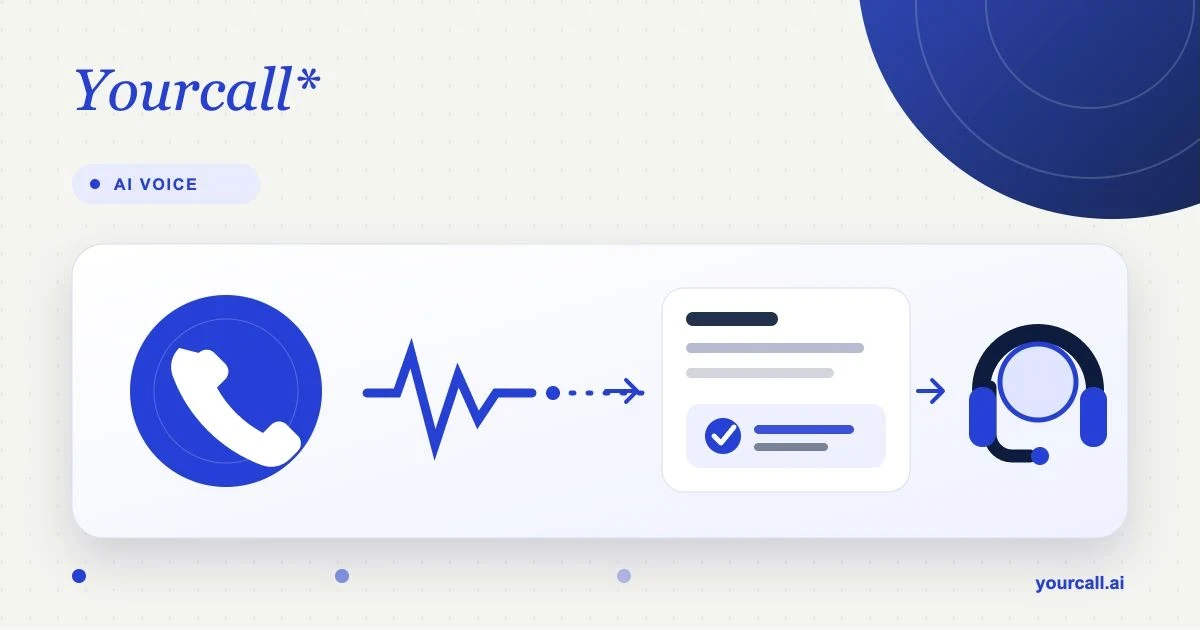
The AI voice agent is no longer just an innovation topic. It has become a real organizational lever for companies that want to better manage their calls without endlessly growing their teams.
The context clearly pushes in this direction. Service teams are looking to move faster, better absorb volumes, and smooth the transition between automation and human interaction.
Here are 7 practical use cases to test with a defined scope, clear handoff rules, and success measures drawn from your own call data.
01Filter and qualify incoming calls
Instead of sending every caller into the same queue, a configured AI voice agent can classify the reason for the call: support, sales, appointment, billing, after-sales, or a predefined urgent path. Qualification accuracy and routing time should be verified on real calls before the scope expands.
02Handle frequent requests
Hours, request status, documents to send, procedures to follow, first-level information: many operations receive recurring questions. Within an approved knowledge base and configured coverage, AI can handle selected requests and route exceptions without adding them to the front-desk queue.
03Absorb activity peaks
When multiple calls come in at the same time, perceived quality can drop quickly through waiting and abandonment. An AI voice agent can add concurrent capacity for selected call types, reducing pressure on the switchboard. The pilot should verify capacity, completion rate, and escalation quality at realistic peak volumes.
If peak coverage is the main issue, use our decision guide to compare IVR, call centre, and AI-agent approaches.
04Handle after-hours calls
Many opportunities come when the team isn't available: early morning, lunchtime, evenings, weekends. An AI voice agent can extend coverage during agreed hours, qualify in-scope requests, and prepare a structured human follow-up when the caller needs a person.
05Schedule appointments or trigger actions
The value of voice AI doesn't stop at conversation. With the right integrations and permissions, it can take approved actions: scheduling an available appointment, sending validated information, transmitting a summary, creating a request, or redirecting to the right person.
06Prioritize emergencies
Not all calls are equal. Some can wait. Others cannot. An AI voice agent can look for predefined urgency indicators and follow the routing rule attached to them. This must be tested carefully and does not replace emergency services, clinical judgment, or human review of ambiguous situations.
07Free up teams to focus on what matters
This benefit appears when the agent actually completes the selected first-level requests. Measure the handling and escalation rates during the pilot; the verified time saved can then be reassigned to complex cases, relationships, sales, retention, and problem solving.
To compare that operational benefit with the full deployment budget, review the factors that drive AI phone system cost.
Which calls should be entrusted to AI to improve both customer experience and internal efficiency?
At Yourcall, the idea is not to automate for the sake of automation. The idea is to identify the calls where speed, consistency, and qualification save the most time, and let humans step in where they bring the most value.