Many companies still underestimate the real cost of a missed call.
In the moment, it seems harmless. The phone rang. Nobody answered. The customer might call back. The prospect might leave a message. The team will handle it later.
In reality, this 'later' often costs much more than you think.
A missed call is not just a failed interaction. It's sometimes a sale that won't happen. A customer losing trust. An emergency that worsens. An impression of disorganization. An opportunity going to a more responsive competitor.
And this cost doesn't only affect acquisition. It also impacts retention.
Missing a call isn't just losing a few minutes. It's potentially degrading existing revenue and preventing future revenue.
Why this cost is often invisible
The problem is that these losses are rarely visible on a dashboard. A company sees its leads, campaigns, meetings, and sales. But it rarely measures:
- how many calls come in outside business hours;
- how many calls are dropped during activity peaks;
- how many prospects give up before being attended to;
- how many simple requests monopolize the team;
- how many high-intent opportunities cool down before a response.
How to measure the real cost of missed calls
To start quantifying this cost, ask yourself some simple questions:
- What is your volume of incoming calls per week?
- How many go unanswered or are poorly handled?
- How many of these calls involve a commercial intent, an emergency, or an existing customer?
- What is the average basket size or the average value of a retained customer?
Even without a complex formula, this gives you a range to validate: the revenue exposure depends on the share of calls that were recoverable, their intent, and the conversion rate observed after a response.
How Yourcall helps reduce this hidden cost
One operational response is to extend coverage on selected lines, hours, and call types instead of relying only on who happens to be available.
To assess that response, compare IVR, call centre, and AI-agent operating models against the requirements of each call type.
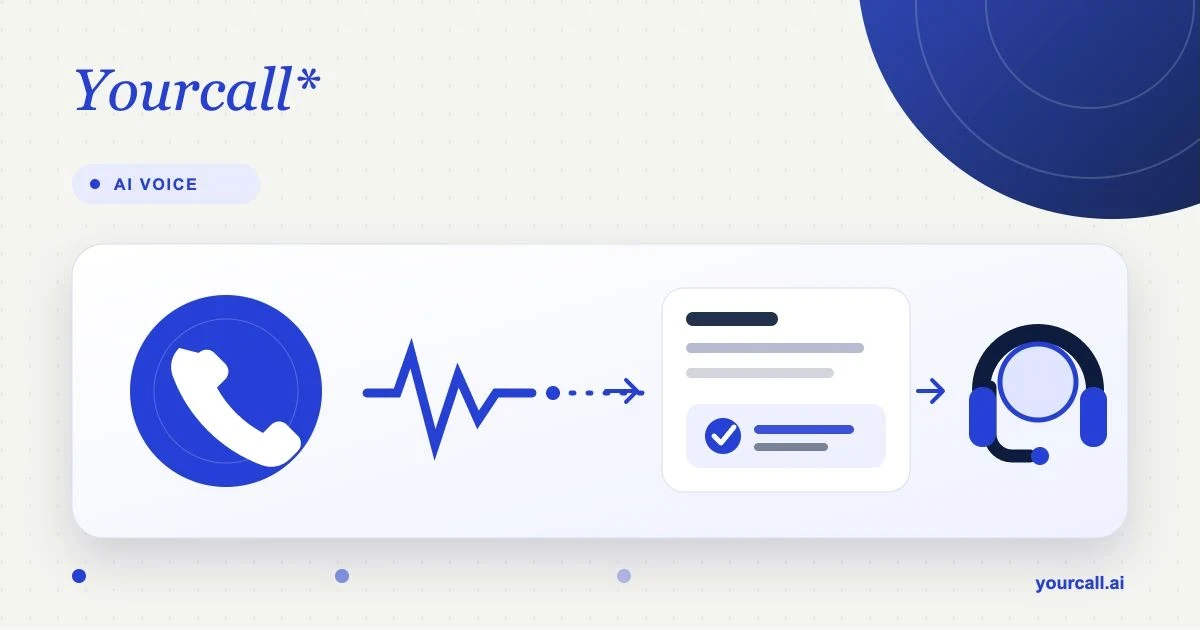
That's where a solution like Yourcall can be tested. Within the configured call flow, voice AI can answer promptly, qualify the request, complete approved tasks when connected to the relevant system, apply predefined urgency routing, transfer according to the handoff rules, and create a record of the calls it handles.
For a hotel, review the dedicated reservation, front-desk and overflow call workflows, then compare them with the documented deployment scope of the Hôtel des Trois Couronnes case.
That is more than a simple 'auto-answer,' but its commercial value should be verified against handled-call rate, task completion, conversion, escalation quality, and full operating cost during a controlled pilot.
Use our AI phone system pricing framework to identify the billing models, cost drivers, and budget items that belong in that full-cost comparison.
The real challenge isn't replacing a team. The real challenge is preventing your company's growth from being capped by its ability to answer the phone at the right time.
Better coverage may recover more qualified opportunities.
Better qualification can reduce avoidable routing work.
More consistent handling can support a more reliable customer experience.
The next step is simple: measure the current gap, test one call type, and compare the result with the baseline.